




PREVIOUS PAGE
NEXT PAGE




DEMONKIND
MAGICAL ALIGNMENT: Dark, always following a sin.
LIFESPAN: Most demons, save for certain subspecies*, have a lifespan only slightly longer than that of a human’s (70-140). Due to their durability and advanced magical ability, they are extremely durable and unlikely to die by means other than old age, especially pure demonic beings.
APPEARANCE: There is a large biodiversity within demonkind, and, as such, they have no set appearance, rather a list of potential traits. The most common traits observed in demons are horns, pointed ears and arrow tipped tails. Their tails also have the potential to be prehensile, spade-tipped or even fur tipped. The possibilities are endless.
Unusually coloured eyes and unusually coloured
pupils are also a trademark of demonkind; their
eyes may glow, shimmer, or shift in hue when
powers are being utilised.

More uncommon or even rare features of a demon include:
- Feline or reptilian eyes.
- Forked tongues.
- Sharpened teeth.
- Unnaturally coloured hair.
- Coloured sclera.
- Colourful markings on the skin.
- Unnaturally coloured skin.
- The hooves of a goat.
- Mouths, eyes or even spikes across
the body.

*Shades (described below) may be around for several millennia, swapping from vessel to vessel.


There are also numerous subspecies of demon, usually associated with a specific sin. These subspecies have specific colourations, traits and abilities,* such as:
PRIDE: This subspecies have the largest, most ornate horns, and sometimes possess feathered wings and tail-tips.
GREED: Pure greed demons are fairly rare, but those who do exist possess shiny, metallic horns.
LUST: Descendants of succubi and incubi, lust demons are curvy, effeminate and possess spade-tipped tails.
ENVY: This subspecies does not have a 'defining' characteristic, but shorter tails are common.
GLUTTONY: Gluttony demons are far more likely to possess an extra mouth, or extra tail(s).
WRATH: Goat-like features, such as hooves, furred legs and fur-tipped tails.


*The vast majority of demonkind within modern day Embers Edge are somewhere between two or more of these pantheons.
Demons are not restricted to these traits.

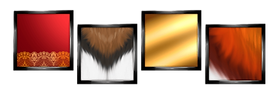




SLOTH: Rounded features, either lacking a tail-tip or having a 'v' shaped tail-tip.
SHADOW DEMON: Also known as shades, this demon subspecies does not have a corporeal form and exists through possession only.
OVERALL BIOLOGY:
Just as the appearance of a demon may
vary widely, so can their biology. Their
organs mostly follow a similar structure to
that of a human’s, with some very minor differences (the lack of an appendix is extremely common, for example).


ABILITIES: Listing every single possible power that a demon may possess would take days, as the possibilities are almost endless.
- Demons and demon hybrids are far more likely to have multiple powers.
- The most common power for a demon is pyrokinesis.
- As with most dark mana abilities, a demon’s abilities are
usually destructive and can be rather dangerous if uncontrolled.
- The most powerful demons may be capable of altering reality
itself.
DIET: A demon’s diet is indistinguishable from a human’s. Unless they are hybridised with other magical fauna, demons are versatile omnivores.
SLEEP/REST: As with their diet, demonkind require a similar amount of sleep or rest as a human.
REPRODUCTION: From conception to gestation, there is little to note about the reproduction of most demons, it is almost entirely the same as that of a human.
The most notable difference is that pure lust demons possess a “female” reproductive system, as well as a “male” one. These may be 'switched' between at will.




HYBRIDISATION: There is a small handful of light mana species that a demon can seamlessly hybridise with, always producing a dark equivalent.
- A demon and an angel will always produce a
'false fallen angel'. Often shortened to 'false FAs',
these beings possess both demonic and angelic traits,
such as wings (bat or feathered), horns and halos.
These are not the same as fallen angels.
- A demon and a nymph will, similarly, produce a 'false decayed
nymph', blending traits of both species. These are not the same
as decayed nymphs.

- A demon and a harpie will produce a 'singed harpie'. These
are not a standalone species.
- A demon and a kitsune will produce a 'kukan kitsune'.
These are not a standalone species.
- A demon and merfolk combo will produce a
siren, indistinguishable from the standalone species.
- A demon and fae combo will produce an imp, indistinguishable from the standalone species.
- A demon and lithan combo will produce a magman, indistinguishable from the standalone species.
- A demon and silican combo will produce a gyel, indistinguishable from the standalone species.
- A shadow demon and mothfolk combo will produce a dreamwalker, indistinguishable from the standalone species.
Demons can have offspring with werebeasts or animalfolk, though these work slightly differently.*
- A demon and animalfolk combo has a 70% chance of producing a werebeast,
a 20% chance of a demon, and a 10% chance of combining the two.
- A demon and werebeast combo has a 45% chance of producing a werebeast, a 45% chance of producing a demon, and a 10% chance of combining the two.
A demon and a dragonborn can hybridise incredibly easily, though
offspring are always categorised as dragonborns.

*Any canine and demon hybrid (for example, a demon werewolf), is known as a hellhound.

CULTURE:
Although demonkind as we know it originated in Eastern Asia, these demon-human hybrids have assimilated with our society centuries ago and spread worldwide. Therefore, although culture and tradition are important to them, it ranges massively depending on their ethnicity and heritage.
Unfortunately, bloodline ‘purity’ is a large part of demon culture, and some families frown upon further hybridisation. Conservative and traditionalist families place a large focus on preserving the traits of their sin pantheon, marrying solely within their sin.
ORIGIN: Modern day demons have existed as long as archives span, as the result of hellborns inter-breeding with humans. This is why demons as we know them appear far more humanoid.
CHILDHOOD AND DEVELOPMENT:
- Much like young cattle and goats, demon infants (sometimes called devils) are usually born with small, hard plates on their foreheads known as horn buds. In early childhood, these plates begin to grow keratin, eventually developing into their characteristic horns. This is to protect the birthing parent from internal damage during birth.
- Similarly, a sharp tail tip may be soft at birth, and harden with age.*
SEXUAL DIMORPHISM: Contrary to popular belief, demons are not a dual-sex species. There is a wide spectrum of sexual characteristics and androgyny within demon kind, including intersex demons and those who possess both, or no reproductive organs.*
This spectrum is visible through the length and size of horns, the length of tails and the height of demons. Typically, larger horns are a more masculine characteristic, and females have a larger stature, but these are not strict rules - chromosomal sex is incredibly jumbled within demonkind.

Bloodline curses are extremely common in demon lineages.

There are classes available at the university to study demonology, and the origins of demonkind as we know it. They are the most researched species.

*Almost all demonkind possess some magical ability, and these abilities will begin to make themselves known during puberty. In the early days, these powers can be difficult to control, especially when teenage hormones are added into the mix.