








PREVIOUS PAGE
NEXT PAGE


KITSUNE
MAGICAL ALIGNMENT: Light and virtue following, with the exception of kukan kitsune.
There are 13 subspecies of kitsune, each with varying appearances, lifespans and magical abilities. Most kitsune are a blend between two or more subspecies, though powers are always tied to these categories.
In order of magical prowess:
TENGOKU: Also known as light kitsune, tengoku are extremely angelic beings, often possessing the ability to astral project or the ability to control and manipulate light itself. Their animalistic features are white or ivory with coloured, striped markings, usually red. They are unable to die of old age, and upon unnatural death, can be reborn (with an additional tail).


SEISHIN: Or, spirit kitsune, walk a fine line between the living and the dead. They are usually capable of some form of possession, telepathy, or the manipulation of emotions. They are not immortal (living 100-200 years), but remain able to appear in the overworld after death (as spirits). Their animalistic features resemble that of a marble fox.

*All kitsune possess the ability to transform wholly into a fox.

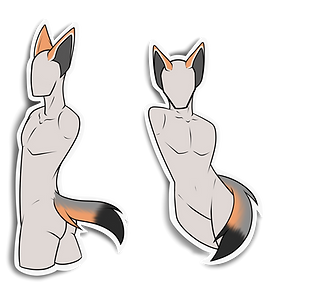
Art by sabortoof_teegar




JIKAN: Known as time kitsune, these beings can bend time to their will (somewhat). Slowing, pausing or even reversing time itself. Along with this ability, they can often manipulate gravity in some way, shape or form. They have fairly average lifespans, 70-90 years, and their animalistic features resemble that of a tibetan fox.
ONGAKU: Also known as sound kitsune, ongaku possess a wide array of sound and music related magical abilities - echokinesis, musical empathy and sonic blasts, to name a few. They have fairly average lifespans, 70-90 years, and their animalistic features resemble a blandford’s fox.

SANDA: Or thunder kitsune, are exactly what they say on the tin. They can summon thunder, electricity, or even control the weather. Some may exert so much energy that they injure themselves, but are mostly immune to being electrocuted. They naturally live around 120 years, and their animalistic features resemble that of a swift fox.
KASAI: Known as fire kitsune, kasai kitsune are also relatively self explanatory. They possess various forms of pyrokinesis and thermokinesis, and live for around 70-90 years. Their animalistic forms resemble that of a fennec fox.


KAZE: Also known as wind kitsune, kaze have aerokinesis in all its forms, usually summoning small tornadoes or utilising the wind as a form of telekinesis. They live slightly longer than other kitsune (up to 110 years) and their animalistic features resemble that of a kit fox.


CHIKYU: Or earth kitsune, can manipulate the ground beneath them to their will via both terrakinesis, the manipulation of earth, and agrokinesis, the manipulation of plants. They are the shortest-lived subspecies, rarely surpassing 70 years. Despite this, they are strong, hardy, and their animalistic features resemble that of a darwin’s fox.


YAMA: Also known as mountain kitsune, some yama possess a similar form of terrakinesis. Their possible powers also include cryokinesis and temperature control (specifically freezing). They live for 70-100 years, and their animalistic features resemble that of an arctic fox, or a silver fox.
MORI: Or forest kitsune, are the most common variation of kitsune. Their abilities usually include being very in tune with nature, communicating with animals, controlling animals as well as lesser agrokinesis. They live for 70-90 years, and their animalistic attributes usually resemble that of a red fox.


UMI: Known as ocean kitsune, these kitsune possess the ability to manipulate liquids, usually water, hardening or partially solidifying it to form whatever shape they wish. They can also, rarely, summon rainfall. They have fairly average lifespans (70-90 years), and their animalistic features resemble those of an island fox.


KAWA: Or river kitsune, are the least powerful form of kitsune. They often possess the ability to summon rainfall, and gelidkinesis, the ability to change the viscosity of liquid. They live for 70-90 years, and their animalistic features resemble that of a crab-eating fox.
A special mention is needed for KUKAN, or void kitsune. These are the result of hybridisation, the offspring of a demon and any type of kitsune, though they are their own subspecies. They possess magical powers such as pain absorption, illusion casting and umbrakinesis, and both a sin and a virtue. They are often surprisingly long lived (200-400 years), and their animal attributes usually resemble a bat-eared fox.
Appearance wise, kitsune do not need to follow their categories’ feratype* or rules, but their powers must at least somewhat correlate with the type of kitsune they are. This is just a little guide!
Family members often share the same subspecies, but bloodlines are often very muddled.

*Feratype - the animal which a magical being shares traits with.


APPEARANCE: As pictured above, all kitsune possess the ears and tail of a fox. Though 'natural' colourations are vastly more common, bright pigments aren't unheard of, especially if one parent is not a kitsune.
Most kitsune look relatively similar, with a few rare variations.
- Upon living a full century, rebirth, a redeemable act (i.e saving a life), or an extreme magical feat, a kitsune may gain a tail. No kitsune has ever surpassed nine tails.
- Very rarely, a kitsune may grow thick fur on their cheeks.

OVERALL BIOLOGY: The similarities between kitsune and human biology are undeniable. and as such, it would be simpler to list parts of their physiology which they do not share. For starters, all kitsune subspecies have flexible, fast metabolisms, though not exceptionally fast. Some subspecies, namely kasai kitsune, may even slow their metabolic rate at will. Overall wound healing is also notably quicker than in other humanoids, and these beings as a whole tend to have particularly resilient immune systems.
DIET: If there's one thing that kitsunes adore, it's food in all its forms. Although it's a common misconception that these fox-folk are carnivorous, these creatures are actually total omnivores. To retain proper nutrition, a varied and consistent diet is necessary, with the average kitsune requiring at least 3000 calories per day. Typical meals include cooked (or fried) chicken, fresh fruit and berries, and grains, often all at once.
SLEEP/REST: Kitsune typically need 9-10 hours of sleep in a 24 hour period, but it is rare that this rest is fulfilled all at once. Whether this is an evolutionary adaptation, or simply learned behaviour, the majority of kitsune take an abundance of naps throughout both the day and night. Although most follow the social norms of having a designated bedroom, some kitsune are willing and able to sleep practically anywhere. If you catch a kitsune napping on a park bench, try not to disturb them!

REPRODUCTION: Peculiarly, female kitsune (vixens) are only known to ovulate once or twice a year. There is an incredibly small window to become pregnant, around one week. This may be yet another trait they share with overworld foxes, or perhaps a result of their extended lifespans. Consequently, reproduction is almost wholly intentional and by choice for these fauna. Once successfully expecting, their gestation period is unusually short. It varies from subspecies to subspecies, but, typically, a kitsune pregnancy lasts around four months. Much like werebeasts and animalfolk, kitsune are slightly more prone to giving birth to multiples, and virtually all vixens forgo menopause.
HYBRISIDATION: Although not totally unprecedented, a kitsune being born an inter-species hybrid is considered a rare genetic abnormality. There are less than a hundred documented kitsune 'hybrids' within Embers Edge as of 2067, and the majority of these are dragonborn-kitsune.*
Ordinarily, in the case that a kitsune bares a child with a member of another species, the resulting offspring is either-or species. A parent of another species can, however, influence a pup's subspecies. For example, the child of a kitsune and a siren is overwhelmingly likely to be an umi or kawa kitsune.
There are two exceptions to this:
A demon and any form of kitsune will always produce a kukan kitsune.
An angel and any form of kitsune will always produce a tengoku kitsune.
SEXUAL DIMORPHISM: Aside from the usual humanoid secondary sex characteristics, there is no dramatic physical difference between a male kitsune (a 'dog') and a female kitsune (a 'vixen'). Additionally, genetic conditions such as chromosomal variations and even chimerism are fairly common within kitsune, and as such around 8% of kitsune are born intersex in some way.

*As dragonborns are often able to pick up any and all traits from other magical fauna, these hybrids are technically still considered fullblooded dragonborns (with foxlike features).



ORIGIN: Analogous with almost all other light-mana beings, kitsune are the carefully crafted creation of nymphs. Distant descendants of the now extinct foxfolk, these creatures have served one sole purpose throughout all of history - maintaining local ecosystems. Aside from tengoku, who are believed to have served angels, all other kitsune subspecies aided nymphs in preserving local wildlife and weather patterns. Kitsune have existed on-record since the 8th century.
After this, these beings tend to follow a standard humanoid timeline of development. Most go through seasonal shedding cycles, and, by around 15-18 years old, will finally display their adult colourations.
CHILDHOOD AND DEVELOPMENT:
Kitsune young, known as cubs, pups or even kits, are remarkably helpless for the first few months of life. All are born unable to open their (temporarily) crystal-blue eyes, and are far smaller than the average infant. After the first month of life, a young kit begins its accelerated development. Crawling, standing for short periods, eating solids and even rudimentary speech are all possible within the first six months of life.
CULTURE: Not all kitsune are religious or engaged in spirituality, but those who do lean towards ancient East-Asian practices, such as Shinto or various subsects of Buddhism. Typically, kitsune do not follow a strict set of rules and rather follow a more freeform model of spiritually, engaging in spiritual cleansing, providing offerings to chosen deities, or keeping a small household altar in good nick.
Although the majority of kitsune are of East-Asian descent, some originate from Europe, South America or are even Native American, thus following their own set of beliefs. They are a very culturally diverse group.


(Art by sabortoof_teegar)